
There is no universal cleaning schedule that fits every data center. A lightly trafficked enterprise server room, a high-density colocation facility, a hyperscale campus, and an AI-oriented compute environment can have materially different service requirements. The right cadence depends on operating profile, risk exposure, equipment density, airflow design, maintenance activity, audit expectations, customer requirements, and tolerance for disruption.
The market environment makes this question more important. Data centers are no longer a niche real estate category. Global demand is expanding rapidly, and AI is accelerating the need for larger, denser, and more power-intensive facilities. Research from leading infrastructure and real estate firms points to substantial new capacity requirements through 2030, while global occupancy remains extremely high. In supply-constrained markets, facility teams are under pressure to operate existing environments with greater discipline while new capacity is planned, built, and commissioned.
Cleaning frequency should therefore be treated as an operating policy, not a generic vendor schedule.
A practical framework begins by separating cleaning into three categories: event-based cleaning, periodic deep cleaning, and ongoing maintenance.
Event-based cleaning is triggered by a defined condition. Examples include construction completion, equipment refresh, pre-audit preparation, visible contamination, maintenance work, water intrusion, cable work, customer walkthrough preparation, or facility reset activity. These events create discrete risk windows and should be handled with scope-specific planning.
Periodic deep cleaning addresses accumulated contamination across defined zones. Depending on facility conditions, this may occur quarterly, semiannually, or annually. The right interval should reflect environmental history, access patterns, construction exposure, underfloor conditions, and internal cleanliness standards.
Ongoing maintenance programs are tied to recurring operating requirements. These programs are less about one-time cleaning intensity and more about consistency. They should be connected to service-level expectations, documentation needs, facility zones, inspection cadence, and performance tracking.
The reason frequency matters is that contamination is dynamic. Particulate can enter or accumulate through foot traffic, packaging materials, outdoor air, loading areas, vendor work, maintenance activity, construction adjacency, and movement beneath raised floors or through overhead spaces. A stable, low-traffic environment may require a different cadence than a facility undergoing repeated fit-out work or high levels of contractor access.
The operating context also matters. The International Energy Agency has highlighted that servers account for roughly 60% of electricity demand in modern data centers on average, while cooling and environmental control can range from about 7% of consumption in efficient hyperscale environments to more than 30% in less-efficient enterprise facilities. That does not mean cleaning alone determines energy efficiency. It does mean that environmental control is economically meaningful, and airflow pathways should be managed with discipline.
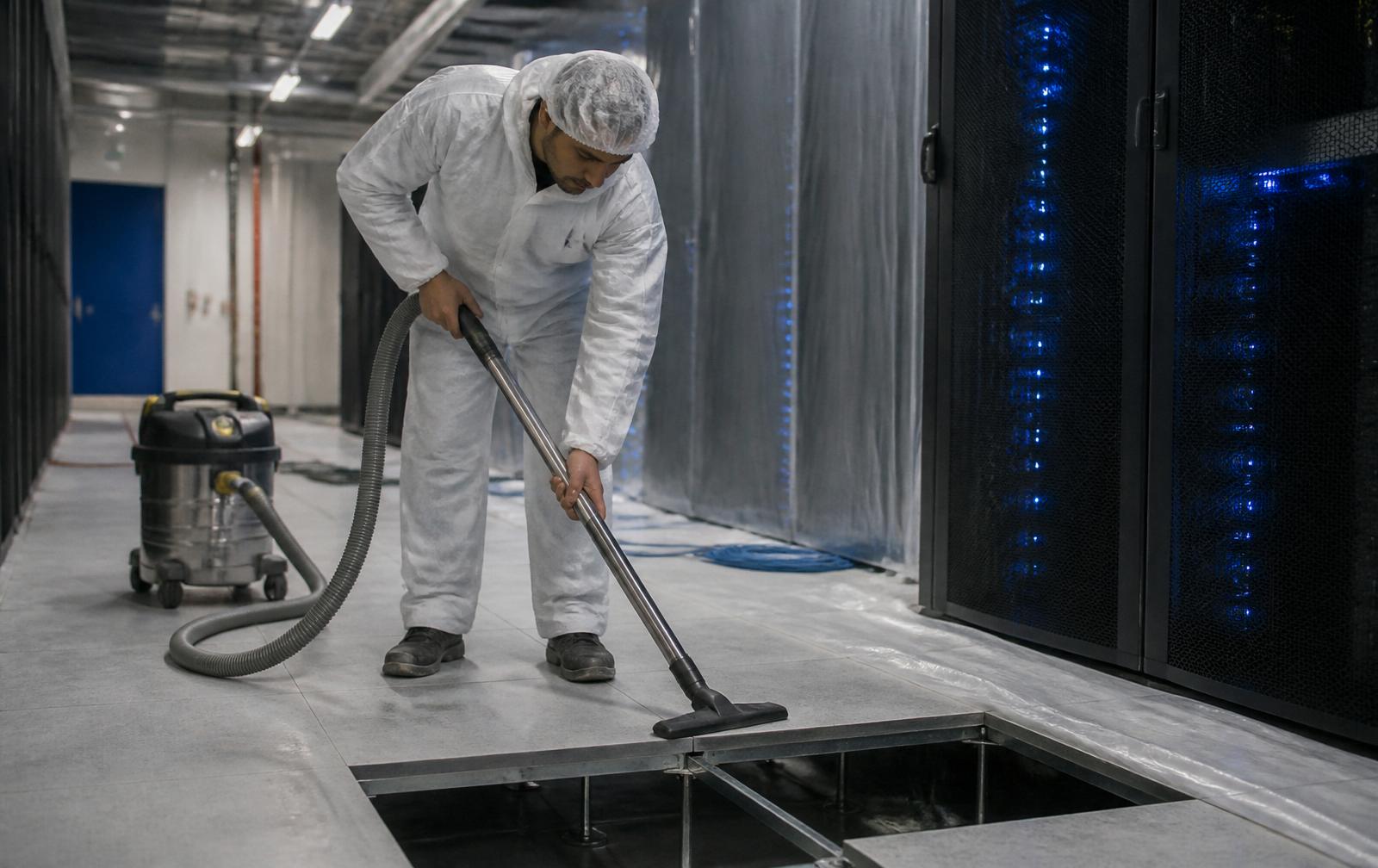
A strong operating model should segment the facility by risk. Data halls, loading paths, staging areas, MDF rooms, mechanical corridors, raised floor areas, construction-adjacent zones, and customer-facing areas may each require different treatment. A high-traffic area may need more frequent maintenance. A raised-floor environment may require periodic underfloor review. A pre-audit environment may require more documentation. A stable environment may benefit from targeted verification rather than broad intervention.
Documentation is the difference between service activity and service control. Without records, operators may know that cleaning occurred, but not which zones were completed, what exceptions were observed, whether issues repeated, or whether service aligned with the facility's operating standards. That gap creates uncertainty for operations teams, procurement leaders, audit stakeholders, and customer-facing teams.
A strong program should answer five questions: What was cleaned? Where was work performed? When was it completed? What was observed? What requires follow-up?
Capitol Core's view is that cleaning frequency should be right-sized through facility risk, condition history, operating requirements, and documentation needs. A recurring maintenance program should not be a generic calendar entry. It should be tied to defined scope, facility zones, service cadence, reporting requirements, and performance indicators.
The objective is not to clean more often than necessary. The objective is to create the right level of control for the environment.